
The Creative Graphic Visualization is a special course developed by the Media Team as a fresh approach on expanding the students imagination. Here, the reading materials are famous comic books that tackles certain topics, from the the simplest to the most complex. From the simplest lesson of teamwork to the philposophical implications, political and religious symbolisms of these stories, comic books have become a new medium to spark interest for learning.
For nearly a century, comic books have become the vehicle for every man, woman and child’s imagination. Despite its reputation, it has been proven that it can be used as a tool for learning to enhance a learner’s comprehension and analytical skills.
Long time advocate, Illya Kowalchuk has always believed that comics is the way to reinforce literacy skills and develop a strong student-teacher relationship with marginalized students. His belief led him to be part of a non-profit organization called Pop Culture Classroom wherein they utilize materials like comic books, video games and other forms of pop-culture references as a means to increase literacy in order to build community that celebrates diversity and self-expression.
His work inspired the media team to develop this special course. This course aims to further develop the students’ storytelling abilities while at the same time utilizing the individual imagination of the learners in order for their literacy skills to flourish and breakthrough the surface of their analytical skills.
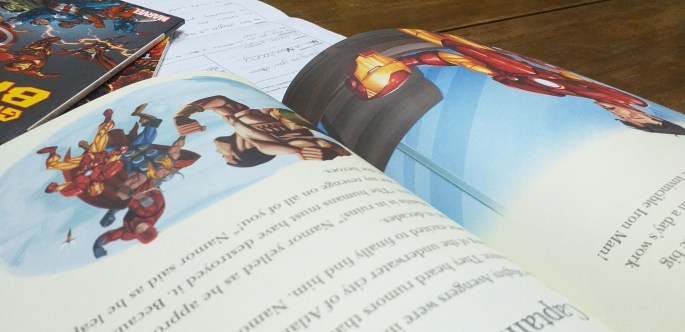
5-Minute Marvel Stories
Introduction to Comic Books
The class was implemented on June 11 on a Tuesday. The class only consists one student namely, Lee Ye Geon. On our first day of class, he was reintroduced to the world of comics. We discussed the brief history of the comic book world, how it began as comedy comics, to horror, to science-fiction, and of course the most famous genre: THE SUPERHEROES.
What interested me the most is how much of the culture fans aren’t aware of. Like how the comics originated from Japanese culture and was later on brought in America in the 1930’s and was popularized by companies like DC Comics and Marvel in the early 40’s and 60’s. With the popularity of movies like The Dark Knight and Iron Man, there have been an increase in comic book sales in 2008 according to Comichron.
Themes & Subjects in Comic Book
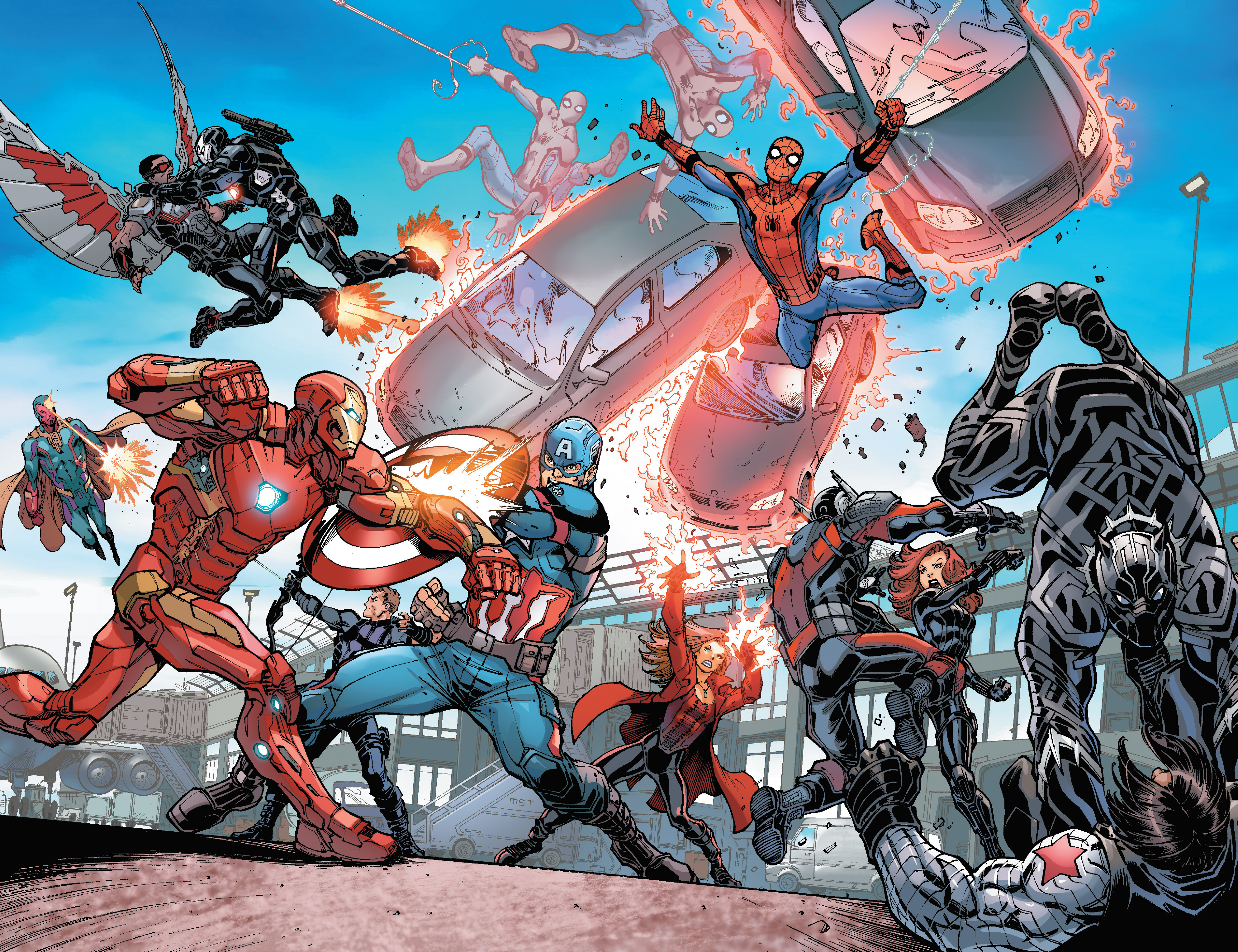
With it’s rich history of storytelling, comic books have brought us numerous storylines that tackled topics like politics, abuse, death, psychology, and many more. The industry grew from a medium for entertainment into the voice for many people all over the world. Frank Miller’s The Dark Knight Returns tackles PTSD and the control of the government over individuals with powers is a critically acclaimed story in the 80’s which not only reinvented Batman but also how comic books should be written. It later inspired writers to develop more complex stories like Marvel’s companywide crossover, Civil War, the basis for the movie version, asks the question: “Should these people be responsible for the destruction they cause even if it saved countless of lives?”
Stories like these are what pushed educators to used comic books and graphic novels as materials in the classroom. It is a fun way for learners to ask more how and why questions that develop their critical thinking and analytical skills. This would also allow them to express their own views through their work. Writers like Jose Rizal used their works to voice out their opinions and morals that help inspire people to be brave and stick to their values. Writing had always been the voice for people who are too shy to be under the spotlight, this course is a chance for students like Ye Geon to express themselves and to show the world that their ideas matter.

Art by: Doug Mahnke and Christian Alamy
Visual Writing
Just on our first day, Ye Geon already shared concepts of his story. He had already developed a short plot outline of how the story is going to go. It’s going to be a very hard journey, since there’d only be two people working on his comic book. Me and him. Ye Geon will write, being that I am the teacher, I will of course edit. Both of us will be working together on the art. It’s a small team but he is very eager to share his story to me and everyone else.
Ye Geon is already familiar with the basic elements of a plot but we still had a discussion about the other forms of a plot like the episodic plot, which is mostly used to connect multiple plots in order to make a TV show. Another is a parallel plot, an outline that writers used if they wish to compose a story for individual characters that would later be culminated in either the climax or the end of the story. A technique that writers also choose is starting a story right in the middle and later unfolding the narrative in a series of flashback that would later lead to the beginning of the story. Ye Geon opted to use the dramatic plot since it is the most common one and easiest to use as his guide to write his very own story.
Ye Geon’s Original Content
At the end of our first day, Ye Geon was able to pitch an idea for his story. For the sake of his intellectual property, I won’t disclose any specific details. Rather I would only share the premise he had conjured up. He pitched a story of a young boy who fought for his dream to come true by playing a sport that left his family with trauma that forbids him from doing so. It is a very heart warming comic book that is very rare nowadays. Most comics have opted for spectacle and shocks; only a handful of comics are able to deliver a very personal and intimate story. I can not wait for his story to flourish so that everyone will see how imaginative this boy is and how much effort he is willing to exert to show his talent in writing. Till then, I hope that all true believers will keep reading the blog for further updates. Excelsior!

